
More robot choice without switching systems
By Sebastian Schmidt
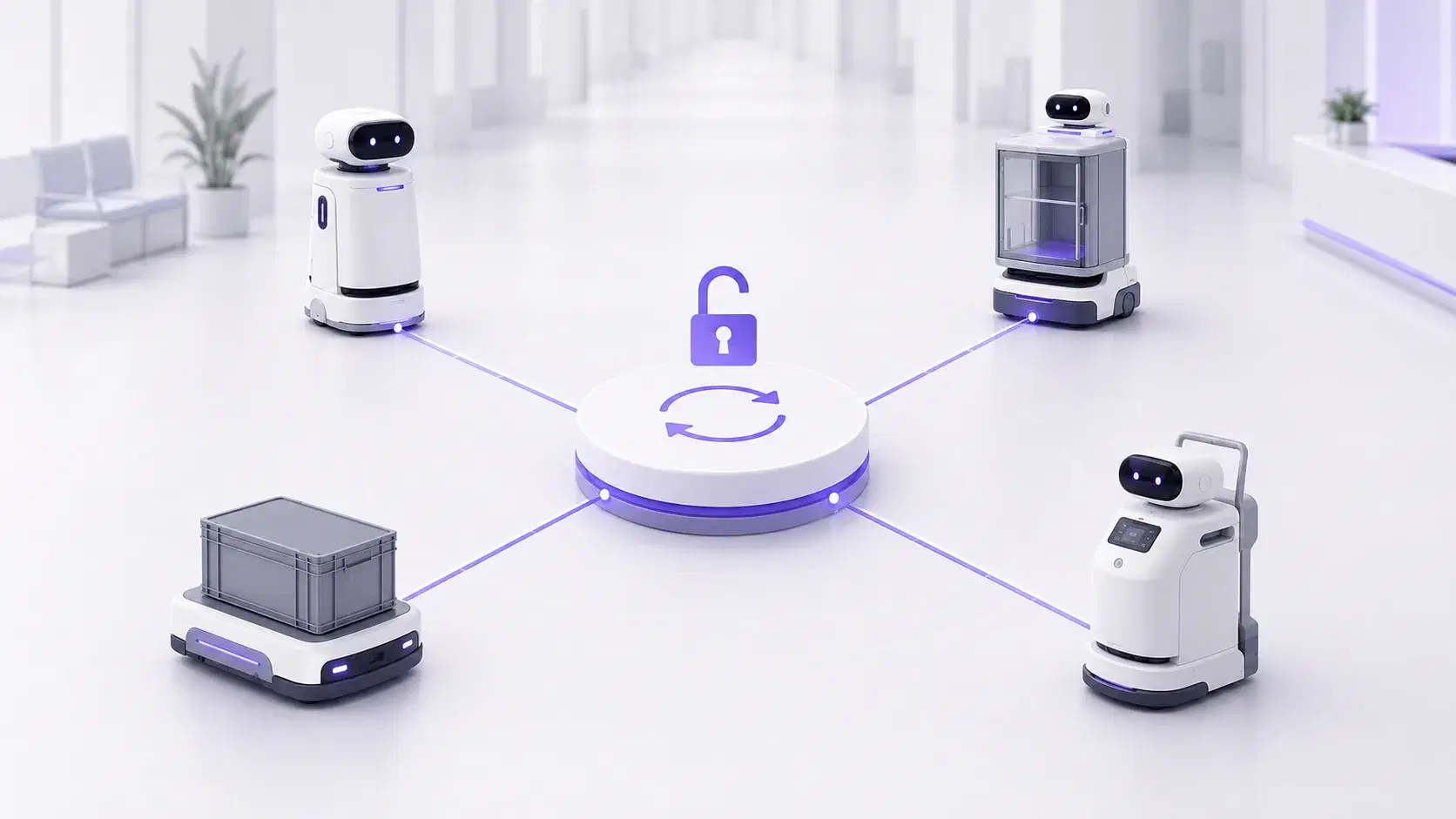
You want to pick the right robot for the task, not the one that happens to fit your system. Yet that is often the problem today: once a robot is hard-wired into doors, elevators, or your IT, every later change gets expensive. A neutral control layer turns that around. It decides whether robotics stays a one-off purchase in your facility or becomes an infrastructure that grows with you over the years.
Why direct coupling leads to lock-in
When a robot is integrated into your processes in a vendor-specific way, dependencies form that are hard to untangle. A second vendor then means a second integration, its own interfaces, its own operation. That slows down tenders, makes expansions costlier, and ties you to the roadmap and prices of a single supplier. Robotics does not scale through the fastest robot, but through an infrastructure in which models are interchangeable.
The cost of that dependency rarely shows up on day one. It surfaces later: when a model is discontinued, when an elevator is modernised, when a second site is added, or when the supplier's prices change. Each of these situations becomes a small project, because the connection between robot and building was only ever meant for that one device. What starts as a pragmatic point solution grows into a collection of special cases that no one can fully oversee any more.
There is also a strategic imbalance. Whoever is technically tied negotiates from a weaker position. A tender that in practice only one vendor can satisfy is no longer a real tender. This is exactly the negotiating position buyers want to reclaim, and they reclaim it only through architecture, not through better contracts.
The idea: one common layer instead of many point connections
Instead of connecting each robot individually to each system, a common layer coordinates the tasks and access to the infrastructure. You connect doors, elevators, and third-party systems once. New robot models dock onto the same layer through adapters. That lowers integration risk and turns selection into a functional decision rather than a technical one-way street.
The difference is the one between point-to-point cabling and a shared standard connector. In the first case the number of connections grows with every new device and every new system; in the second the outside world stays stable for the robots, no matter who supplies the next model. The complexity does not disappear, but it moves to the right place: into a layer that is built cleanly and maintained once, instead of into dozens of improvised direct connections.
This also changes who makes which decision. The question "which robot?" becomes a functional question about task, environment, and suitability again. The question "how does it reach the door and the elevator?" is already answered, because the layer takes care of it. Selection and integration are decoupled, and that is precisely what creates room to manoeuvre.
How Axiona implements this
Axiona is the vendor-agnostic layer between robots and the outside world. Robots, doors, elevators, and third-party systems connect through a common integration layer, without proprietary point solutions per vendor. Many proven robot models and elevator controllers are already integrated, which lowers integration risk. On the same foundation we build the industry solutions hospOS, shoppiOS, lodgOS, tutoOS, aviaOS, and fabOS. Which robot fits which task is shown model by model in the comparison.
That the same foundation carries several industries is not a coincidence but the core of the approach. A hospital, a retail operation, a hotel, and a production site have different workflows but the same basic requirement: robots have to move reliably through doors and elevators and talk to existing systems. Once that shared substructure is built solidly, every industry solution benefits from it, and each new integration serves more than a single customer.
An honest note: vendor-neutral does not mean every device works identically on day one. We distinguish integration maturity transparently as validated, integrated, and supported, instead of claiming blanket compatibility. This gradation is deliberate: it tells you before procurement how much effort and how much certainty a given model actually carries, instead of giving you a promise that only proves dependable, or not, once it is in operation.
What this means for procurement and operations
For procurement, the leverage shifts. Once you have a neutral layer, you can tender models by suitability and genuinely compare suppliers, because a change is no longer a system swap. Expansions become more predictable, because an additional robot docks onto an existing connection instead of triggering a new integration project.
For operations, stability matters most. Doors and elevators are safety-relevant systems; they should be connected cleanly exactly once and then run reliably, regardless of which robot model is currently driving. A common layer reduces the number of places where something can go wrong and makes maintenance and troubleshooting more manageable. That is less spectacular than the fastest robot in the brochure, but it is exactly what makes the difference between a pilot and a lasting operation.
Evidence from practice
In our reference environments, models from several vendors run through the same platform, for example Keenon, OrionStar, and temi, combined with elevator controllers such as KONE or GWH. Which models are offline- or elevator-capable and validated with Axiona is documented in the service robot comparison.
The fact that devices from different vendors are deliberately operated side by side here is the real evidence. Not a single model that works, but interchangeability itself is the outcome the neutral layer is meant to deliver. The documented comparison makes that suitability verifiable, rather than merely asserting it.
Next step
If you want to keep your options open, the neutral layer pays off from the start. It costs a little more diligence up front and pays back through every later decision it keeps open for you. Talk to us about your use case, or look at the solutions overview.